
The Rock Creek
Retreat
A secondary home in Rock Creek designed around a single idea: that every space should serve the art of gathering. From the back patio that connects every room to the lake views beyond, this home was built to bring people together — for business dinners and fishing weekends, for celebrations and quiet evenings, for a life lived generously at the water's edge.
Welcoming and Grandiose
The owners came from Dallas with a clear purpose. He runs a medical device company and wanted a home where he could host clients and colleagues in a setting that felt elevated but never formal — a place where a business dinner on the back patio could transition into cigars by the fire pit without anyone needing to leave. She wanted a home that was elegant with a flash of personality — a place refined enough for an evening with friends but relaxed enough for a weekend with the children and their friends.
Their brief to the architect was two words: welcoming and grandiose. A lakehouse that felt generous in scale and warm in character. A home where the back patio, the living room, the kitchen, the bar, and the game room all connected to one unifying outdoor space so that no matter where you were, you were part of the gathering.
The home also needed to accommodate the lake life that brought them to Rock Creek: oversized garages for boats and lake toys, a bunk room with full-size adult beds for fishing weekends when a dozen friends might stay over, and direct access to a boat stall at the Rock Creek marina. Every room in the home would serve the life they intended to live there.
Architecture That Solved
Three Problems at Once

The Rock Creek lot presented a challenge that would have limited a less creative team. The owners needed garages large enough for boats and lake toys — far larger than a standard two-car garage. But in a community like Rock Creek, where design standards protect the character of the neighborhood, a home with oversized garages dominating the front elevation would never have been approved — and would not have been worth building.
Roberth’s solution addressed three problems simultaneously. He split the structure into a central main house flanked by two lower garage wings, so the massing read as a composed estate rather than a single monolithic building. He dropped the garage rooflines below the main structure, subordinating them visually to the grand entrance at the center. And he raised the main floor, creating the stair entrance that gives the home its sense of arrival while providing the ceiling height below for the oversized garage bays.
The result is a home that feels both expansive and proportioned. From the front, what you see is the entrance: stone columns, a timber-framed peak with windows stacked three high, and a stair that draws you upward. The garages are there, but they are not the story.
One detail captures the inventiveness of the design. What appears from the outside to be a stone chimney is actually a light source — a tower with windows on multiple faces that channels natural light down into the kitchen, arriving through a skylight at the intersection of two gable rooflines. It is the most distinctive ceiling the team has ever built.
Every Room Opens
to the Same Sky
The back patio is not an addition to the home. It is the organizing idea. Roberth designed the structure so that every major space — the master suite, the game room, the living room, the kitchen, the bar — opens directly onto a single connected outdoor living area. The patio is where the home comes together. A dinner party flows from the kitchen to the outdoor table. The game room empties onto the patio for evening air. The master suite opens to a private section where the owners can step outside without entering the shared space.
Off the front of the living room, a separate alcove creates what the team calls the smoking lounge — a space where the host and his guests can retreat with cigars and whiskey without the smoke drifting across the main patio. It is a small detail, but it is the kind of detail that only emerges when the architect asks how the owner actually wants to use the home, hour by hour, through an evening.
Elegant, with a Flash
of Personality
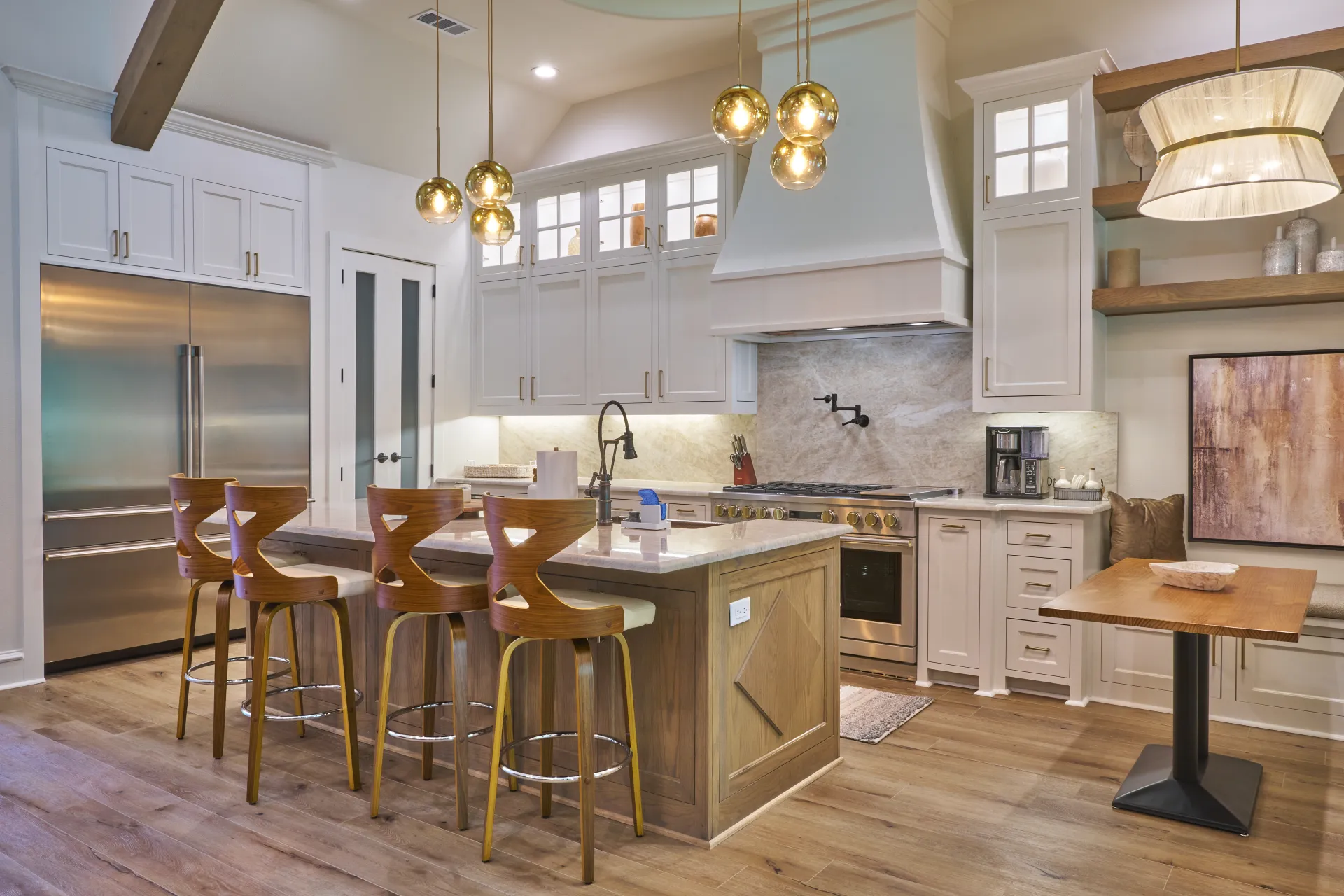
The interior design strategy for this home was one of the most sophisticated the team had worked on. The wife had a strong vision — elegant but not boring, refined but with moments of personality. Heather's response was to keep the color palette subtle throughout the main living spaces while varying the sheen: matte walls against satin trim, gloss accents catching light at different angles. The result highlights the architecture — the ceiling details, the window placements, the spatial proportions — without competing with it.
Then, in the bar, everything changes. The materials shift. The mood turns swanky. It is the same design hand but a completely different register — a room designed for a different hour of the evening.
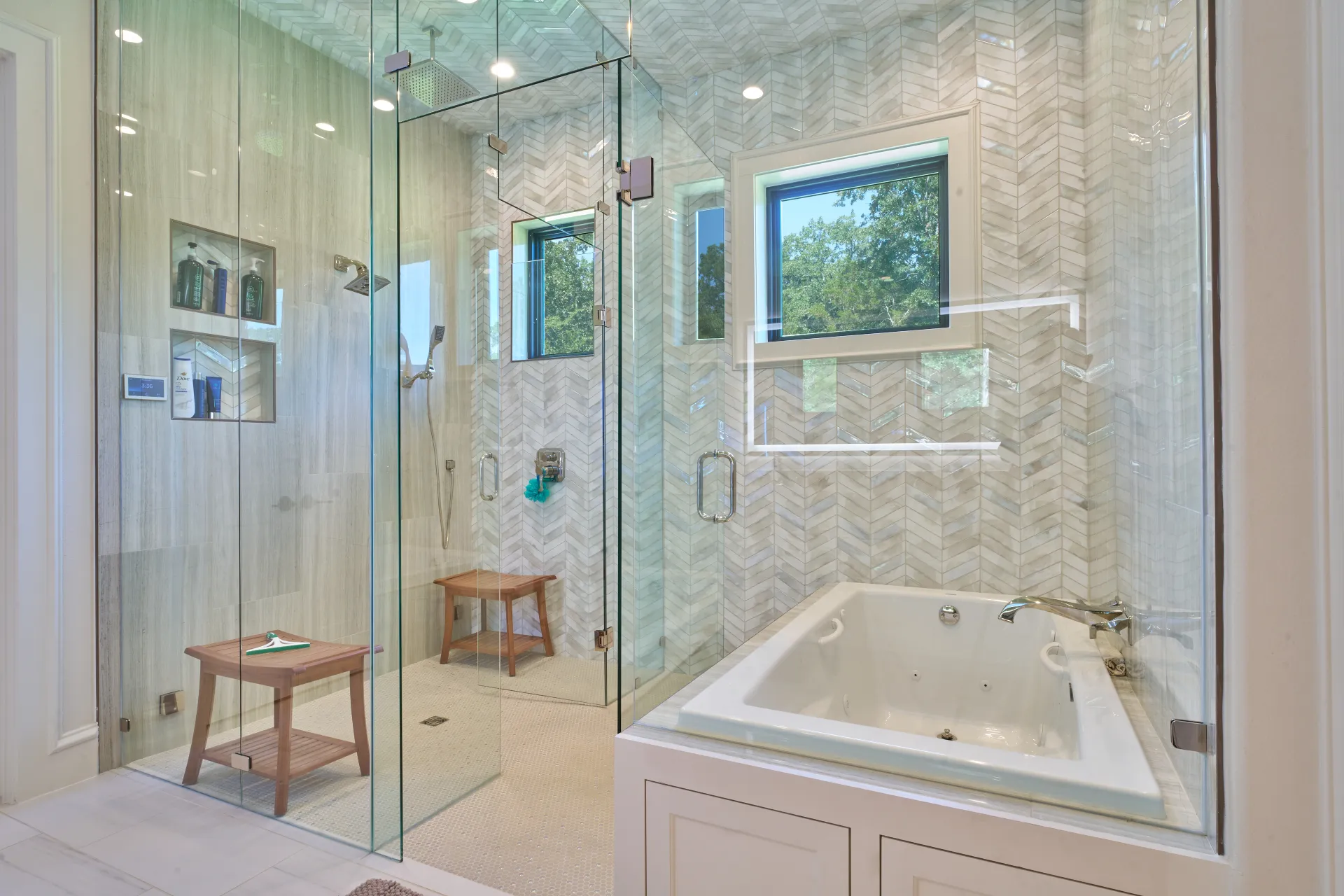
The master bathroom captures the level of craftsmanship that runs through the home: a glass-enclosed steam shower lined in chevron marble tile, with natural light entering through windows that frame the trees outside. It is a room where every material was chosen, placed, and verified — the process described throughout this site, visible in every surface.
From Sketch to Stone
The Concept
The Result
This is where it started. Roberth's hand-drawn concept sketch — produced after the first conversation, after the site analysis, after hearing the words "welcoming and grandiose" — became the reference the owners carried through the entire process. When decisions needed to be made about rooflines, stone placement, or the proportions of the entrance, they returned to this drawing.
The finished home honors it. The proportions, the massing, the relationship between the central entrance and the flanking wings — all traceable to the hand-rendered concept. This is what the design process produces: a home so clearly imagined at the beginning that the result feels inevitable rather than assembled.
Living Exactly as Intended
The home is doing what it was designed to do. The owners host regularly — bringing friends and colleagues to the lake for weekends that move from the kitchen to the patio to the fire pit without anyone needing directions. The bunk room fills for fishing trips. The back patio has hosted gatherings that range from quiet family dinners to celebrations with dozens of guests. The garages hold the boats and the lake toys that make the weekends possible.
The home has had an influence beyond its owners. Since its completion, it has shaped the expectations of nearly every client who has walked through it. Features and solutions developed for this project — the split-structure massing, the light chimney, the way the connected patio unifies the plan — have found their way into subsequent designs. It is the kind of project that changes how a team thinks about what is possible.
Project Details
Location · Rock Creek, Lake Texoma, Texas
Type · Secondary lakehouse — designed for entertaining and lake life
Key Features · Split-structure architecture, grand stair entrance, connected back patio unifying all major rooms, light chimney with skylight, oversized garages, adult bunk room, smoking lounge, steam shower with chevron marble tile
Architect · Roberth Jordan
Interior Design · Heather Shields
Built by · Ceci Bates Custom Homes