
A Process Designed to Protect
What Matters Most
Building a custom home is one of the most consequential decisions you will make. The process should protect you — your investment, your time, your confidence, and the long-term value of what you are building. Over twenty-six years and more than a thousand homes, we have refined a process that does exactly that. Every step exists for a reason, and the reason is always the same: so that nothing about your home is left to chance.
Why This Process Exists
Most custom home builders describe their process in terms of phases — design, permitting, construction, delivery. Those words are accurate but insufficient. They describe what happens without explaining why it works or what protects you when it does not.
Our process was forged through experience — including the experience of building through a global supply chain disruption that exposed every weakness in the way custom homes were traditionally built. When it became impossible to order materials on a normal timeline, we had to front-load every decision: every material selection, every structural detail, every finish and fixture, chosen and priced before construction began. What we discovered was that this discipline — born out of necessity — produced a fundamentally better outcome for the client. Fewer surprises. Fewer delays. Fewer moments where the budget felt uncertain or the schedule felt unknowable.
So we kept it. We refined it. And now, every home we build benefits from a level of pre-construction planning that most builders reserve for commercial projects — if they do it at all.
The result is a process where you will walk through your finished home on screen before any ground is broken. Where every material in your budget is a real product at a real price, not a placeholder allowance. Where decisions are staged so you face only what is relevant now — not everything at once. And where the same people who design your home are the ones who build it.
“When you drive by these homes years from now, the Ceci Bates sign will be long gone… but your work will still be there.”
— Scott Bates, to subcontractors and trade partners
It Begins
with Listening
The process starts not with drawings but with questions. What does your morning look like? How do you want to arrive at the house? Where will people gather? What does the land offer that the home should capture? The first meeting is a structured conversation designed to understand what you truly want — including what you may not yet know how to articulate.
From that conversation, the people who will actually do the work begin to form the vision. The architect who will design your home is in the room. The interior designer who will guide every material selection is present from the start. The builder whose team will construct it is part of the planning from day one. There is no handoff. No one you have spoken with disappears.
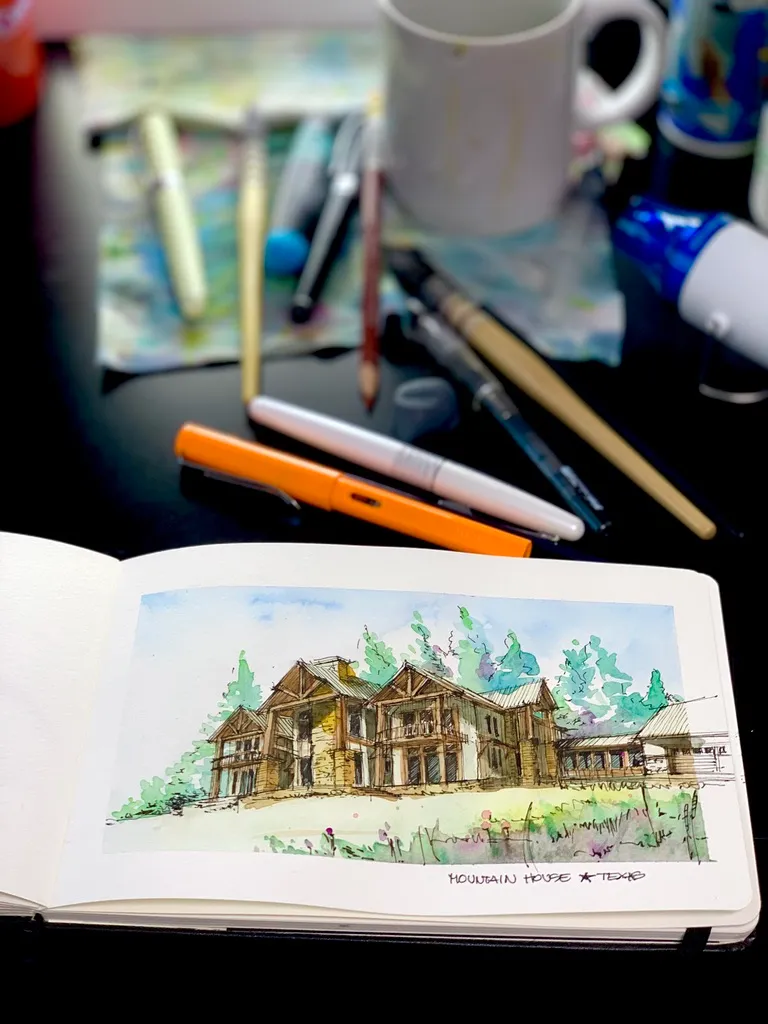
Roberth Jordan, the architect, begins with the land itself — flying a drone to document views at different heights, studying where the sun rises and sets across seasons, identifying the terrain, the trees worth preserving, and the natural approach that creates the strongest sense of arrival. From this analysis, he produces hand-drawn concepts that capture the initial vision — the dreaming phase, where the ideas are big and the possibilities are open.
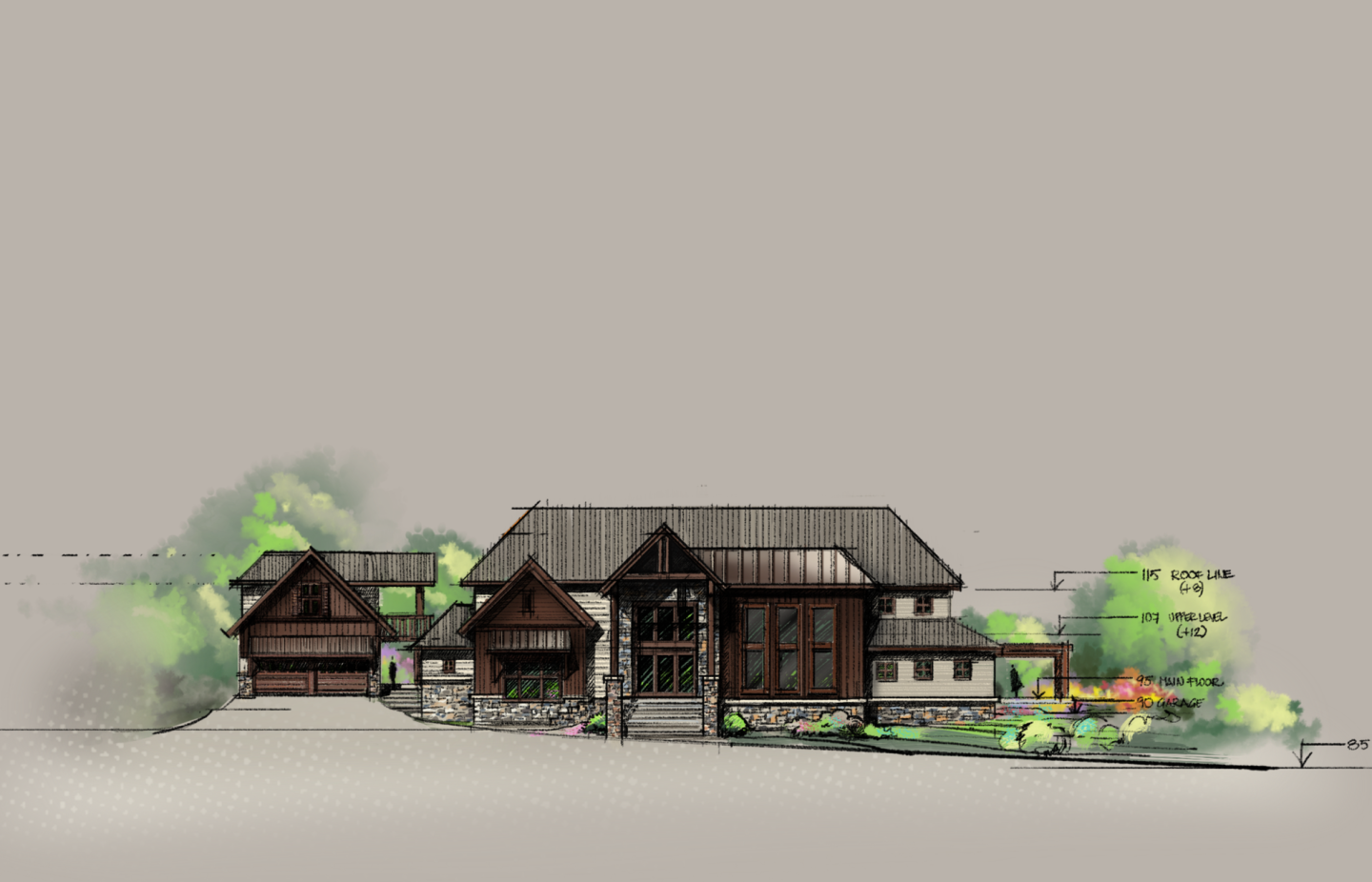
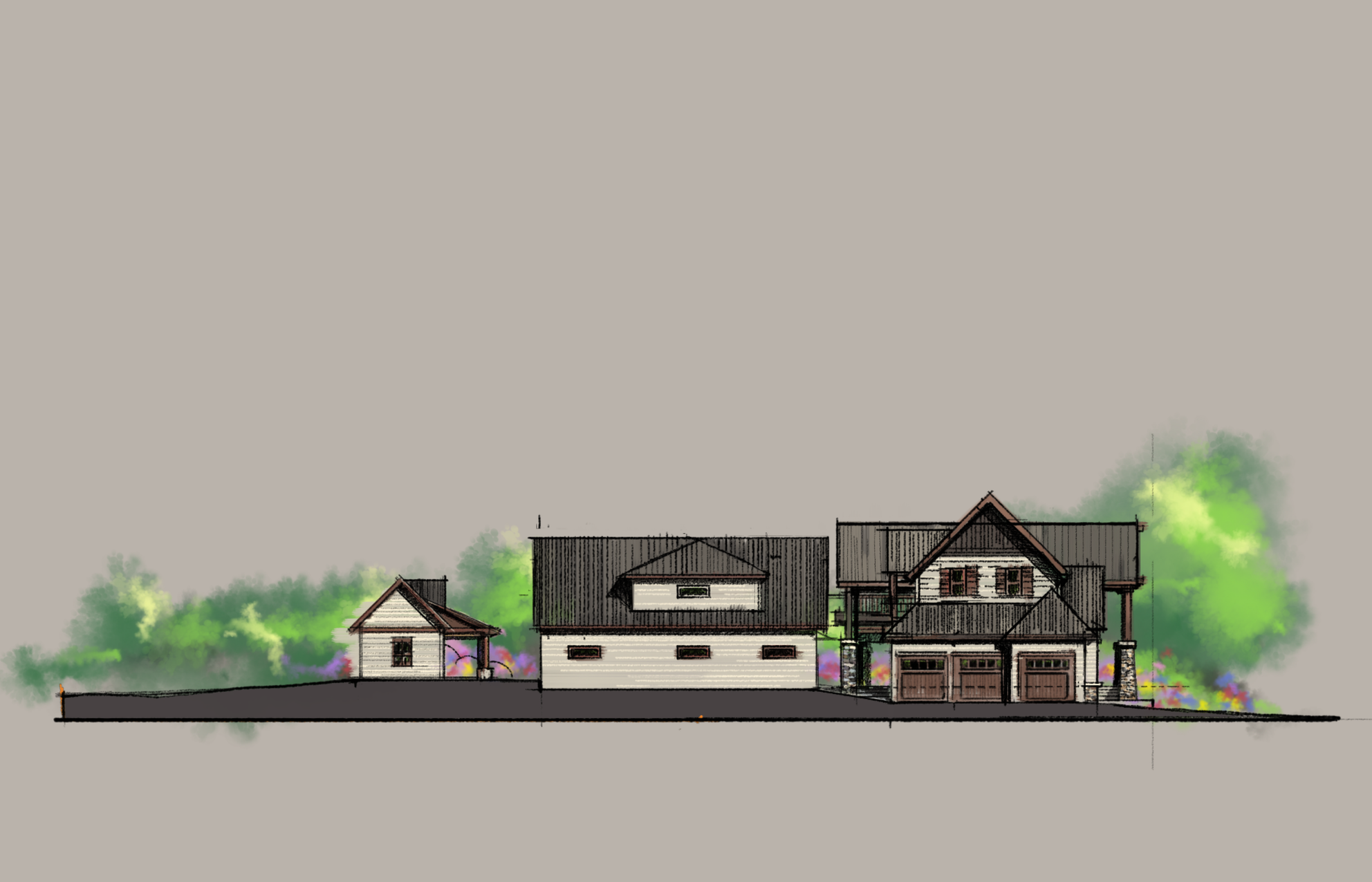
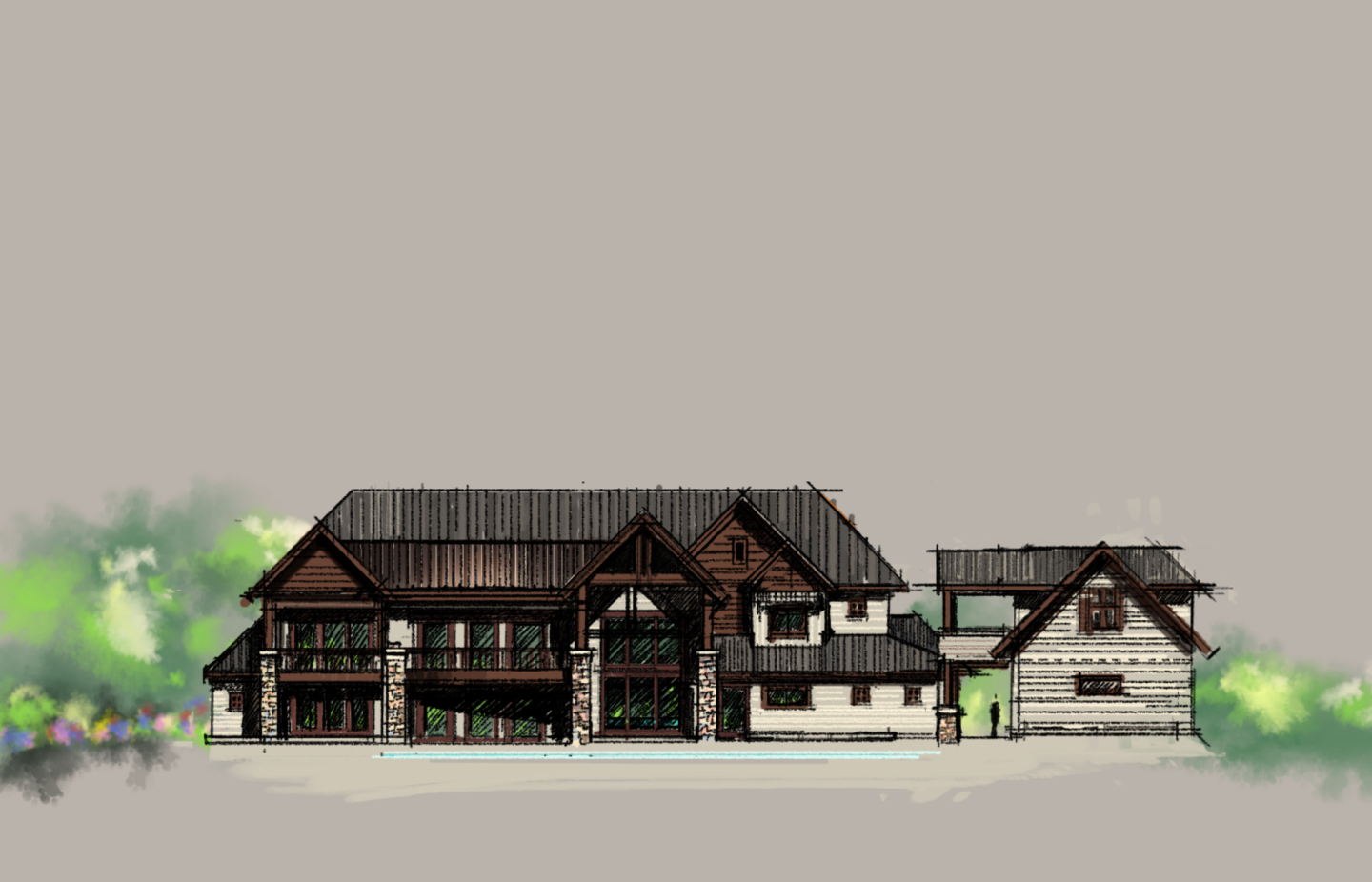
Those concepts evolve into a full three-dimensional model with real materials applied — the actual stone, the actual tile, the actual wood flooring the client has chosen. The model is not a rough sketch. It is a virtual home the client can walk through room by room, seeing how light enters each space, how the ceiling beams look in the species they selected, and how the kitchen island faces the view they fell in love with. Most clients, by the time they have seen their home this way, change very little. The visualization produces confident decisions that hold through construction.

Every Material,
Every Detail
Before the first wall is framed, every material going into your home has been selected, priced, and approved. Heather, the interior designer, works alongside the architect and the builder from the beginning — not after construction has started, but while the design is still being shaped. Her role is not decorative. She guides you through every selection — stone, tile, wood flooring, fixtures, cabinetry, lighting, hardware — ensuring that each choice is beautiful, within budget, and integrated with the architectural and structural plans.
Every selection is rendered in the 3D model so you can see it in context — not a swatch on a sample board, but the actual material in the actual room where it will appear. The countertop you touched at the showroom, shown on the island in your kitchen, under the light fixture you chose, beside the cabinet finish you approved.
The selections are not vague allowances. Every line item in the budget is based on a real product, bid at a real price, with real labor costs to install. If you keep the product you selected, the allowance will be very close to the final cost. If you change your mind, the new selection is priced, compared against the original, and the difference is documented transparently. There is no feeling of being surprised by a change order because every number traces back to a specific product and a specific vendor quote.
Decisions are staged across the project so you face only the choices relevant to the current phase — not everything at once. The structured timeline, guided by Heather and the project manager, means you are never overwhelmed and never making a decision without context or expert support.
Learn more about the interior design processBuilt with the Precision
It Was Designed With
Before construction begins, every structural element in your home has been engineered and documented. Most builders provide one set of plans — architectural drawings that show what the home looks like. We provide two. The structural engineer produces a second complete set that specifies every beam, column, joist, and steel member — sized, located, and load-calculated — so that nothing in the field is left to guesswork. From these plans, a precise material takeoff counts every piece of material going into the home.
At contract signing, purchase orders are issued immediately. Materials are secured at the agreed-upon price and stored at the vendor’s facility until the construction schedule calls for delivery. Your pricing is locked the day the deal is done. No exposure to market fluctuations. No budget surprises from material cost increases during construction.
In the field, three tenured superintendents — Steve Nelson, Brian Ward, and Tony Conklin — translate the precision of the engineering into the finished home. Materials arrive in a planned sequence that matches the construction schedule. Every selection made during pre-construction is re-verified before installation, giving you one final opportunity to confirm your choice now that you can see it in context.
Every phase is documented through CompanyCam — photography and video from the raw lot before any work begins through final completion. If a question ever arises about what is behind a finished wall, the record provides the answer. And the subcontractors who do the work are not strangers. Many have been with the company since the post-2009 rebuilding — relationships built on mutual respect, clear expectations, and a shared commitment to the standard.
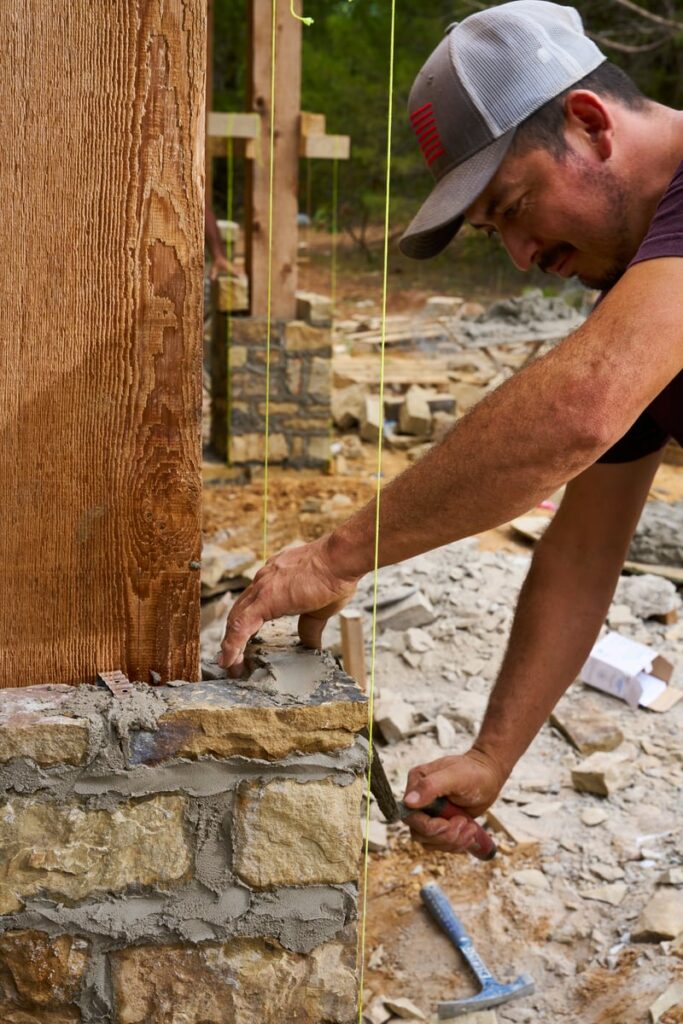
Most custom home builders provide one set of plans — the architectural drawings that show what the home looks like. We produce two. The structural engineer creates a complete second set that documents every beam, every joist, every column, and every steel member — sized, located, and load-calculated before a shovel hits the dirt.
That engineering depth is what makes everything else possible: the precise material takeoff, the price-locking at contract signing, the sequenced deliveries, and the confidence that what was designed on screen is exactly what gets built in the field.
In Their Own Words
The First Step Is a Conversation
If the way we work feels like the right approach for the home you are imagining, we would welcome the opportunity to hear about it. The first conversation is about what matters to you — the land, the life you are planning for, and the kind of home that would serve it. Everything else follows from there.
Begin a ConversationOr explore what we build →Not sure if we are the right fit? →